


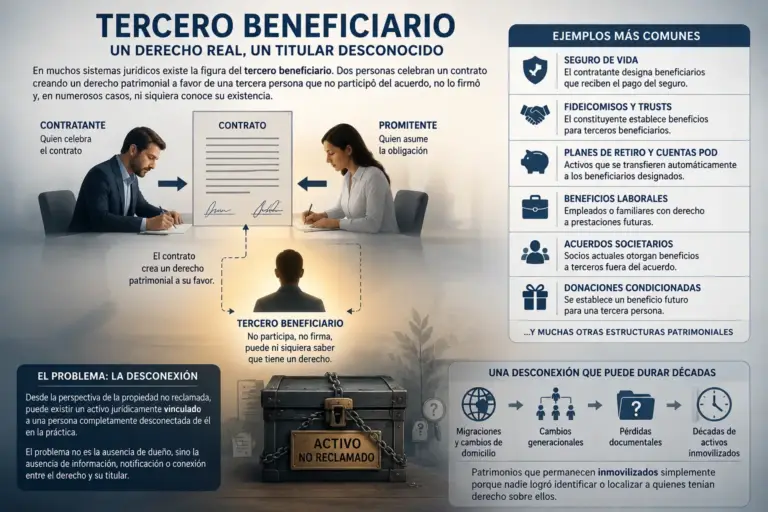
In many legal systems, the concept of the third-party beneficiary exists. These are situations in which two parties enter into a contract creating a property right in favor of a third party who did not participate in the agreement, did not sign it, and in many cases is not even aware of its existence.
The most well-known example is life insurance: the policyholder designates beneficiaries who acquire financial rights even before knowing about them. However, this phenomenon also appears in trusts, retirement plans, payable-on-death accounts, employment benefits, corporate agreements, conditional donations, and multiple modern estate planning structures.
From the perspective of unclaimed property, this concept is particularly interesting because it demonstrates that an asset can be legally linked to a person who is completely disconnected from it in practice. The problem, therefore, is not necessarily the absence of an owner, but rather the absence of information, notification, or connection between the right and its holder.
In some cases, this disconnection can last for decades, spanning migrations, generational changes, or loss of documentation, resulting in assets that remain frozen simply because no one was able to identify or locate those who had rights to them.